
From Knob to Screen: An Interaction Revolution
In today’s world, where digital technology permeates every aspect of daily life, even seemingly simple water dispensers and purifiers are undergoing profound changes in their interaction methods. Knob screen technology—perfectly combining the tactile operation of physical knobs with the visual feedback of digital screens—is becoming the core interactive interface of a new generation of high-end water dispensers, completely changing how we interact with these everyday appliances.
Knob Screen Technology Explained: A Perfect Fusion of Touch and Vision
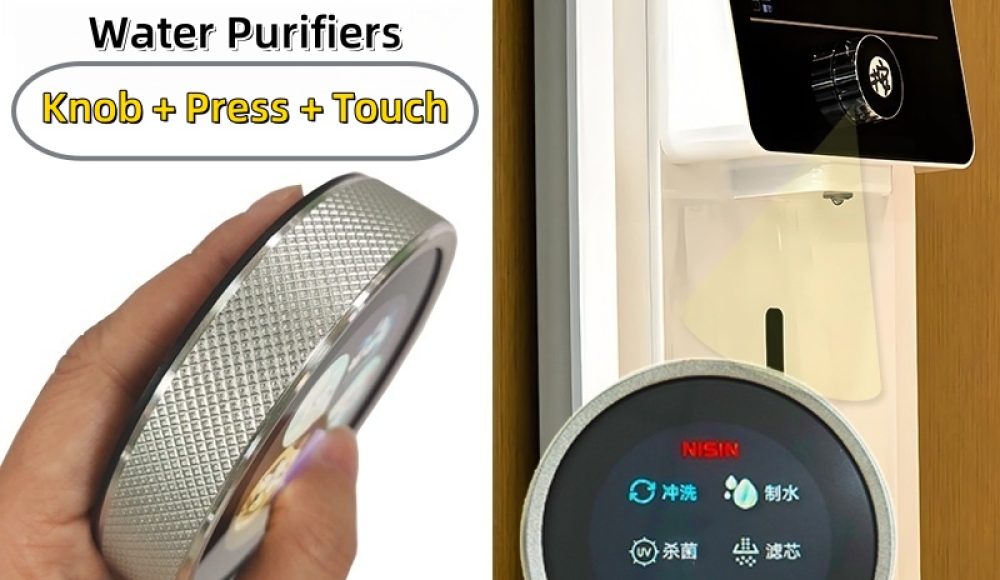
The knob screen is not simply a combination of “Knopf + screen,” but an integrated innovation of an intelligent interaction system:
The physical knob layer retains the advantages of traditional knobs—rotational tactile feedback, precise control, and instant feedback. Users can operate it through muscle memory without visual inspection; this tactile confirmation is something a pure touchscreen cannot provide.
The digital display layer, featuring a high-definition LCD or OLED screen, displays rich information in real-time, including water temperature, water volume, water quality parameters, filter life, and water usage statistics, transforming the traditional “black box” operation of water dispensers into a transparent and visually intelligent experience.
Advantages of Rotary Knob Screens in Water Dispensers
1. Intuitive Bedienung, Bridging the Digital Divide
The rotary knob screen design is particularly suitable for water dispensers, a home appliance used by people of all ages. Children and the elderly may be confused by complex touchscreen menus, but they can quickly master the intuitive operation of “rotating to adjust the temperature and pressing to confirm dispensing water.” Market research by a certain brand shows that water purifiers using rotary knob screens have a 43% higher satisfaction rate among elderly users than pure touchscreen models.
2. Multifunctional Integration, Simplified Interface
Traditional water dispensers often require multiple buttons to achieve different functions. Rotary knob screens, through a unified interaction logic of “rotating to select + pressing to confirm,” combined with a dynamically switching screen interface, integrate functions such as temperature adjustment (room temperature, warm water, hot water), water volume setting (250ml, 500ml, continuous dispensing), and mode selection (tea brewing, milk preparation, coffee) into a single control unit. This simplification is not only aesthetically pleasing but also significantly reduces the user’s learning curve.
3. Transparent Information, Building Trust
For water purifiers, users are most concerned about water safety. The rotary knob display shows key data in real time, including TDS (Total Dissolved Solids), remaining filter life, and water quality change curves. When the user rotates the knob to select different water dispensing modes, the screen simultaneously displays the water quality report and treatment process for that mode. This transparent design significantly enhances the user’s confidence in the water purification effect.
4. Personalized Experience, Intelligent Scene Adaptation. Modern rotary knob displays have memory and learning functions. Zum Beispiel, they can record the common water temperature and volume preferences of different family members and automatically retrieve personal settings when a specific user is identified. They can also suggest suitable drinking water temperatures based on seasonal changes or recommend personalized drinking water plans after connecting to health devices. One high-end model can even learn the user’s tea-brewing habits and automatically optimize the best brewing temperature curve for different teas.
Practical Application Scenarios: How Rotary Knob Screens Change the Drinking Experience
Morning Scenario: Half-asleep, approaching the water dispenser, no need to strain to read the small print buttons; simply rotate the knob by feel to the “Warm Water” area. The screen softly lights up, displaying the current water temperature as 45℃. Press the knob, and a cup of perfectly warm water for morning enjoyment slowly flows out.
Childcare Scenario: When preparing formula for an infant, rotate the knob to select “Formula Preparation Mode.” The screen automatically displays the recommended water temperature (usually 70℃ to kill potential bacteria) and begins a countdown to remind you of the optimal drinking time, ensuring both nutrition and safety.
Entertaining Scenario: When friends visit and ask what they would like to drink, gently rotate the knob. The screen cycles through options such as “Lemonade (Room Temperature),” “Green Tea (85℃),” Und “Coffee (92℃).” After selection, the device automatically prepares water at the corresponding temperature, combining a sense of technology with hospitality.
Maintenance Scenario: When the screen displays “Filter cartridge remaining 15%”, rotating the knob enters the maintenance menu. Replacement instructions can be viewed directly on the screen, and even original filter cartridges can be ordered with a single click, saving the hassle of searching for manuals and matching models.
Technological Challenges and Future Trends: Currently, the application of rotary knob displays in water dispensers still faces some challenges: waterproof and dustproof design, durability under long-term mechanical rotation, and cost control. Jedoch, with technological maturity and large-scale production, these obstacles are being gradually overcome.
In der Zukunft, rotary screen technology will be further integrated with the Internet of Things (IoT) and artificial intelligence (KI):
Voice + Knob Hybrid Interaction: Quickly select major functions via voice commands, then finely adjust using the knob.
Scene Awareness and Adaptation: Automatically raise commonly used water temperatures in winter and suggest more room temperature options in summer using environmental sensors.
Deep Integration of Health Management: Connect to health data to automatically recommend electrolyte replenishment plans after exercise, or remind users of medication times and prepare appropriate water temperatures.
Sustainable Design: Accurately record water consumption, visualize water-saving results, and link with filter media recycling services.
Abschluss: Intelligent Design Returning to Human Nature
In a technology-driven home appliance market, the application of rotary screens in water dispensers represents a valuable reflection: true intelligence is not about functional complexity, but about humanized interaction. It respects humanity’s original preference for physical control while incorporating the rich information of the digital age; it retains the ease of use and reliability of traditional home appliances while integrating the personalized precision of smart devices.
As we pursue intelligent home appliances, rotary screen technology reminds us that the best human-computer interaction is often the design that subtly integrates into human instincts and habits. Every rotation and click is not just about getting a glass of water, but also a warm and reassuring handshake with technology.