
With the rapid development of the smart home industry, microwave ovens, as core kitchen appliances, are upgrading from simple heating tools to “intelligent interactive terminals.” 4.3-pouces 800×480 resolution serial port screens, with their high definition, stable compatibility, and easy integration, have become the preferred solution for microwave oven manufacturers to achieve intelligent transformation. Their 800×480 WVGA high-definition resolution achieves optimized pixel density within a compact 4.3-inch size, combined with the low latency advantage of serial communication, providing users with an intuitive and smooth operating experience while reducing manufacturers’ R&D and production costs. II. Technical Compatibility of the 4.3-inch 800*480 Serial Port Screen: A Core Advantage in Microwave Oven Scenarios
1. The Golden Ratio of Resolution and Size
A 4.3-inch screen is the ideal size for a microwave oven control panel – avoiding the cluttered display of smaller screens (3.5 inches and below) while preventing the panel from becoming too bulky and taking up too much kitchen space with larger screens (5 inches and above). Le 800*480 WVGA resolution achieves a pixel density of 217 IPP, resulting in clear and sharp text and icons. Even elderly users can easily identify key information such as heating mode, temps, and temperature, solving the pain points of blurry buttons and poor display effects in traditional microwave ovens.
2. Stable and Reliable Serial Communication
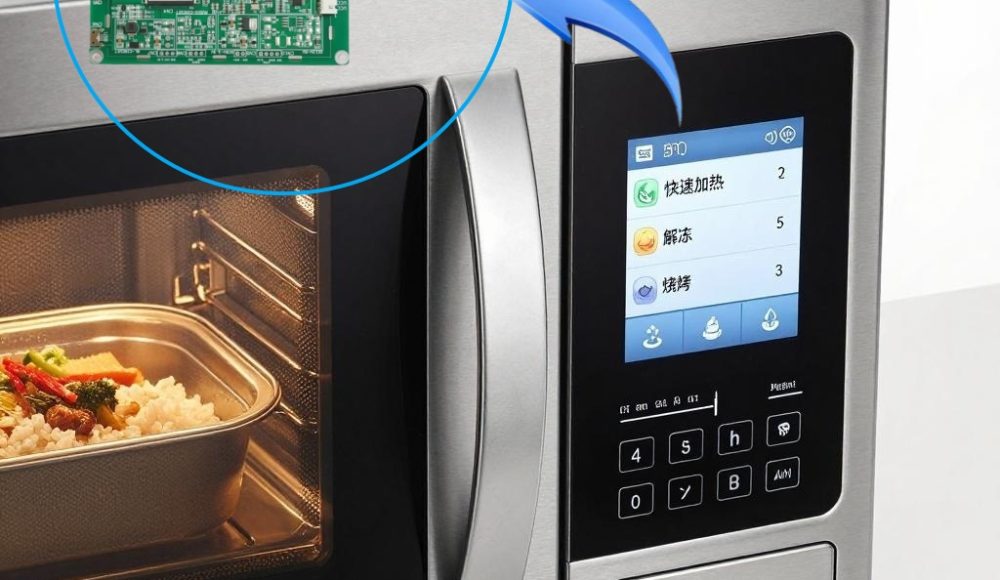
The serial port screen uses mainstream serial communication protocols such as UART and I2C, ensuring strong compatibility with microwave oven main control boards (such as STM32 and MCU). Data transmission latency is less than 10ms, ensuring real-time response to operation commands (par ex., immediate start after clicking “Quick Heating”). Meanwhile, serial communication boasts outstanding anti-interference capabilities, adapting to the electromagnetic environment of a microwave oven during operation, preventing operational malfunctions due to signal interference, and ensuring long-term stable operation of the equipment. 3. Low Power Consumption and Wide Temperature Adaptation Design Microwave ovens operate in environments with temperature fluctuations (panel temperature typically ranges from -10℃ to 60℃). The 4.3-inch serial port screen utilizes an industrial-grade LCD display module, which supports a wide operating temperature range and exhibits low power consumption (standby power consumption ≤5mA, operating power consumption ≤30mA), without increasing the overall energy consumption of the microwave oven. En outre, the screen surface is primarily composed of scratch-resistant and wear-resistant tempered glass, combined with a waterproof and oil-resistant coating, which adapts to the complex operating environment of a kitchen. III. Core Application Scenarios: Reconstructing Microwave Oven Operation Logic
1. Visualized Intelligent Cooking Mode: Traditional microwave ovens’ mechanical buttons or simple digital displays only provide basic time and power adjustments, requiring users to rely on experience to judge cooking parameters. Le 4,3 pouces 800*480 serial port screen supports a graphical user interface (GUI) design and can be equipped with 20+ preset cooking modes (such as defrosting, roasting chicken, heating milk, steaming vegetables, etc.). Each mode is accompanied by corresponding icons, text descriptions, and recommended parameters (temps, température). Users only need to select the type and weight of ingredients through touch operation, and the microwave oven will automatically match the optimal cooking program, reducing the operational threshold. 2. Real-time Status and Parameter Visualization The screen can display the microwave oven’s working status in real time (such as heating, paused, completed), temps restant, current temperature, power level, etc., and dynamically display the cooking process with a progress bar, allowing users to intuitively understand the device’s operation. Par exemple, in defrosting mode, the screen can display the current temperature of the food and the percentage of defrosting completed; after heating is complete, it will remind the user through text + icon + beep notification to avoid leaving the food uneaten for a long time. 3. Customizable Parameters and Memory Function: For professional users, the serial port display supports customized cooking parameters. Users can manually adjust the time (0~60 minutes), power (10%~100%), and temperature (30℃~250℃), and save frequently used parameters as “My Recipes” for direct recall next time. En outre, the screen can record the 5 most recently used cooking modes, allowing users to quickly repeat operations and improve efficiency.
4. Fault Diagnosis and After-Sales Guidance: When the microwave oven malfunctions (such as a door not closed properly, abnormal voltage, or sensor failure), the serial port display will clearly display the fault code and solution (par ex., “E1: Door not closed, please close it again”) using a combination of text and icons, eliminating the need for users to consult complex manuals. En outre, some high-end solutions support connecting the serial port display to a WiFi module to synchronize fault information to a mobile app, facilitating users to contact after-sales service and improving the service experience. IV. Industry Value: A Win-Win Choice for Manufacturers and Users
1. Reduced R&D and Production Costs for Manufacturers
Le 4,3 pouces 800*480 serial port screen is a standardized module. Manufacturers do not need to develop their own display drivers and interface software—suppliers can provide complete SDK development packages and graphical configuration tools, supporting personalized interface customization (such as brand logos and color themes), shortening the R&D cycle by 3-6 months. En outre, the bulk purchase cost of serial port screens is lower (the unit price of a conventional solution is approximately 50-100 RMB), reducing costs by more than 30% compared to the solution of a touch LCD screen + independent driver board, making it suitable for the mass production of mid-to-high-end microwave ovens.
2. Enhanced Product Market Competitiveness
In the context of consumption upgrading, users are increasingly demanding smarter and more user-friendly home appliances. Microwave ovens equipped with a 4.3-inch high-definition serial port screen have a differentiated advantage in appearance design (simple touch panel) and functional experience (visual operation, intelligent mode), helping manufacturers differentiate themselves from low-to-mid-end products and enter the high-end market. Data shows that microwave ovens equipped with high-definition touchscreen serial ports can command a 20% à 50% premium, and user repurchase rates are significantly improved. 3. Adapting to the Future Smart Home Ecosystem
4. The 4.3-inch serial port screen supports extended wireless communication modules such as WiFi and Bluetooth, allowing access to mainstream smart home platforms like HarmonyOS, Mi Home, and Tmall Genie for remote control (such as scheduled heating via mobile app and voice control start). Par exemple, users can set the microwave oven to heat food before leaving work via their mobile phone, and enjoy hot food upon returning home; by saying “Open the microwave oven and heat for 5 minutes” through a voice assistant, the device will automatically respond, aligning with the interactive trends of smart homes. V. Development Prospects: Technological Upgrade Direction of Serial Port Screens in the Microwave Oven Field
À l'avenir, the application of 4.3-inch 800*480 serial port screens in microwave ovens will develop towards higher integration and more intelligent interaction: First, integrating AI visual recognition functions, using the screen’s built-in camera to identify food type and weight, and automatically recommending cooking programs; second, adopting flexible OLED serial port screens to adapt to the curved microwave oven panel design, enhancing the product’s appearance; third, supporting multi-language switching and voice navigation functions to meet the usage needs of different user groups. En outre, with the popularization of IoT technology, serial port screens will become the data interaction hub between microwave ovens and other smart home appliances (such as refrigerators and ovens), realizing full-chain intelligence in the cooking scenario.
VI. Conclusion
With its “high definition, high compatibility, et faible consommation d'énergie” technical characteristics, the 4.3-inch 800*480 resolution serial port screen is perfectly adapted to the usage scenario of microwave ovens, not only reconstructing the user’s operating experience but also helping manufacturers achieve intelligent product upgrades and enhance market competitiveness. With the continued penetration of the smart home industry, serial port displays will become a core feature of kitchen appliances such as microwave ovens, driving the kitchen experience towards greater intelligence, convenience, and personalization.