
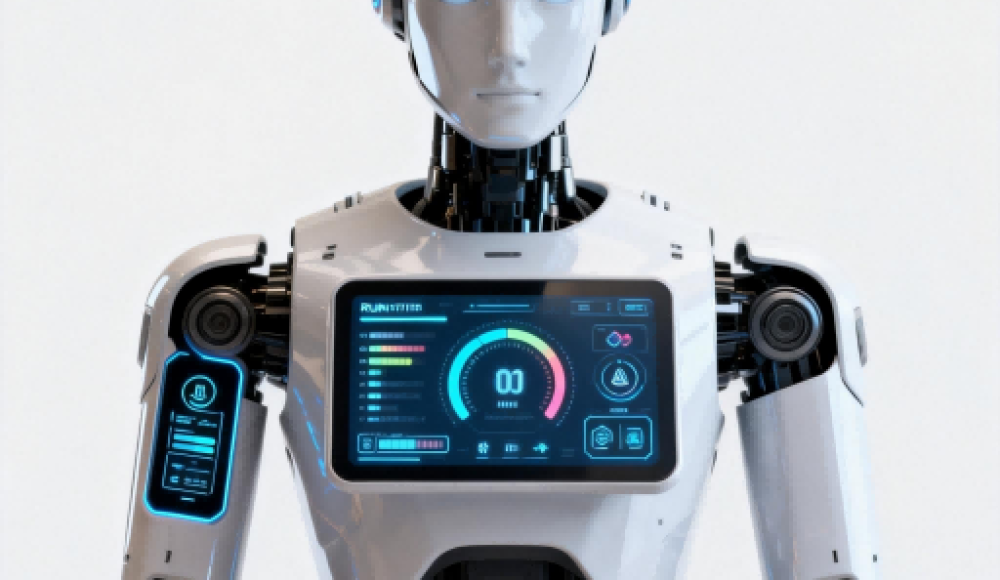
With the iterations of products like the Tesla Optimus and Xiaomi CyberOne, humanoid robots are evolving from simple execution tools into emotionally capable “family companions” 또는 “intelligent employees.” In this evolution, the 10.1-inch LCD screen is playing an increasingly crucial role. It is not only an information output window but also the core interface for robot emotional expression and human-computer interaction.
Visual Entry Point: A Technological Leap from “Faceless” 에게 “Expressive” In the past, humanoid robots often used LED strips or simple panels to indicate status. 하지만, at CES 2026, LG Display clearly stated that the application of display technology in the robotics field is reaching a turning point.
Using a 10.1-inch LCD screen, humanoid robots can achieve the following capabilities:
Dynamic Emotional Expression: By displaying anthropomorphic eyes and expressions on a high-definition IPS screen, robots can make expressions such as smiling, surprise, and thinking, effectively easing the gap between users and cold machines and avoiding the “uncanny valley” effect.
More Intuitive Information Delivery: Compared to voice broadcasts, screens can display weather, schedules, 작업 진행, or error codes more clearly. 예를 들어, in noisy industrial environments, operators can grasp the robot’s status with just a glance at the 1280×800 high-definition data on a 10.1-inch screen.
Key Specifications: Why 10.1 인치?
In industrial design and consumer electronics, 10.1 inches is a golden size. It ensures sufficient display area for complex interactions without taking up too much valuable space in the robot’s chest or head.
According to the latest industry specifications, 10.1-inch screens used in humanoid robots typically have the following characteristics:
High-Resolution Display: Mainstream specifications have reached 1280×800 (WXGA) or even Full HD levels, capable of displaying detailed icons and sharp fonts.
Industrial-Grade Reliability: Humanoid robots need to move and work in various environments. 그러므로, this screen typically needs a wide operating temperature range of -30℃ to 80℃, 고휘도 (1000 CD/㎡) to ensure outdoor visibility, and industrial-grade reliability with vibration resistance.
Touch Interaction: With 10-point capacitive touch technology, users can use gestures to swipe and zoom, just like operating a smartphone.
응용 시나리오: More Than Just a “Face,” It’s a Control Hub
1. Service and Reception Robots
In hotels, shopping malls, or government halls, humanoid business greeting robots equipped with 10.1-inch displays can switch welcome messages in real time, display map navigation, or provide graphic explanations for business inquiries. The screen makes information display more efficiently than simple body language.
2. Industrial and Manufacturing Scenarios
In Industry 4.0 factories, robots are not only labor but also data nodes. A 10.1-inch industrial-grade display can serve as a human-machine interface terminal, displaying real-time sensor data (온도, 습기) and PLC status, and even supporting touch operations for fault diagnosis.
3. Family Companionship and Education
In family settings, screens serve as bridges for emotional connection. Children can interact with robots through screens for educational purposes or video calls. OLED or high-color-gamut LCD screens ensure vibrant colors, attracting children’s attention.
Future Trends: Curved and Flexible Displays
With technological advancements, robot designs are increasingly pursuing a more futuristic appearance. While current mainstream 10.1-inch LCD/OLED solutions are mostly flat or have a fixed curvature, the industry is transitioning to 3D curved screens.
Tesla plans to use a curved OLED screen in the face of its upcoming Optimus robot to fit the spherical design of its head. For current large-scale production, mature 10.1-inch LCD displays, with their cost advantages and mature supply chain, remain the safest and most efficient choice for robot manufacturers.
결론
The competition among humanoid robots is not only about algorithms but also about the “last mile” of interactive experience. A high-quality 10.1-inch LCD screen can transform a machine from a tool into a partner. If you are developing the next generation of humanoid robots, choosing a high-brightness, high-reliability, and wide-viewing-angle display solution will be a key step in enhancing your product’s competitiveness.