
Dans le développement de dispositifs embarqués pour l'automatisation industrielle, équipement médical, Appareils à domicile intelligents, et appareils portables, display screens serve as the core carrier of human-computer interaction. Most hardware engineers and product procurement personnel often face a critical selection dilemma: whether to adopt a cost-effective ordinary display screen or a high-performance smart serial screen.
Although both types of displays can present screen content, they differ fundamentally in technical architecture, development difficulty, main resource occupation, environmental stability, and application scenarios. An inappropriate display selection will lead to prolonged R&Cycles D, unstable device operation, screen flickering, and poor anti-interference ability, which directly affects product quality and market competitiveness.
Based on 14 years of professional R&D and mass production experience in the LCD display industry, this article systematically analyzes the core differences between smart serial screens and ordinary display screens, summarizes applicable industry scenarios, and provides professional selection suggestions for industrial and commercial embedded display projects.
1. Core Definition: Essential Differences in Technical Architecture
The essential gap between smart serial screens and ordinary display screens lies in the internal operating logic and hardware integration structure, rather than superficial functional differences:
1.1 Ordinary Display Screen
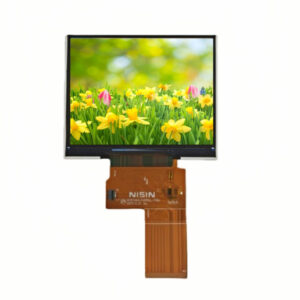
An ordinary display screen is a basic liquid crystal panel component with only simple image display functions. It is not equipped with built-in drive circuits, independent control chips, or interactive logic processing units.
All core tasks including screen rendering, timing control, protocol conversion, and interface refresh rely entirely on the external main control chip. Engineers need to independently write underlying driver codes, configure register parameters, and debug display timing, which puts forward high requirements for professional R&D capabilities.
1.2 Smart Serial Screen (Module LCD HMI industriel)
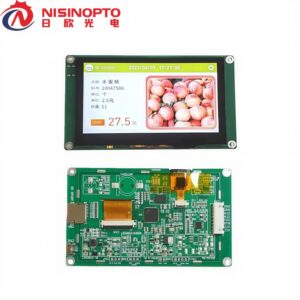
A smart serial screen is an integrated intelligent human-computer interaction display module. It integrates built-in drive circuits, independent control chips, and complete instruction sets. It supports mainstream communication interfaces such as UART, Spice, RS232, et RS485.
Developers can realize one-click screen switching, réglage des paramètres, pop-up window prompting, and human-computer interaction by sending simple serial port instructions, without complex underlying programming. En bref, ordinary screens rely on external main control chips to drive operation, while smart serial screens operate independently with built-in systems.
2. Four Core Differences Between Smart Serial Screen and Ordinary Display Screen
The following multi-dimensional comparison intuitively explains the application advantages of smart serial screens in industrial and commercial scenarios, helping enterprises complete accurate product selection:
2.1 R.&D Development Difficulty
Ordinary Display Screen: The secondary development workload is heavy and the cycle is long. The team needs to complete underlying driver development, timing debugging, and hardware adaptation from scratch. It is easy to encounter adaptation failures and screen refresh abnormalities during the development process, which is not friendly to small R&D teams and novice engineers.
Smart Serial Screen: It greatly simplifies the embedded development process. Equipped with a visual UI design platform and standard universal instruction sets, it supports drag-and-drop interface design and quick function calling. It effectively shortens the product R&cycle D, accelerates product launch speed, and reduces technical thresholds and labor costs.
2.2 Environmental Operation Stability
Ordinary Display Screen: There is no industrial-grade anti-interference circuit design, and the stability completely depends on the adaptation of the external main control board. In complex working environments such as industrial workshops, high-frequency electromagnetic equipment, and vehicle-mounted scenarios, it is prone to electromagnetic interference, resulting in screen flickering, flou, stuttering, and accidental shutdowns, failing to meet industrial and medical stability standards.
Smart Serial Screen: Optimized for harsh industrial scenarios. It is built with professional anti-electromagnetic interference circuits and wide-temperature adaptive design. It can operate stably for a long time in complex electromagnetic environments and extreme temperature scenarios (-20℃ to 70℃), effectively avoiding various display abnormalities and meeting strict industrial-grade operation requirements.
2.3 Main Control Chip Resource Occupation
Ordinary Display Screen: All computing tasks such as screen rendering, interface refresh, and interactive logic processing are borne by the device main control chip, occupying a large amount of CPU computing power and memory resources. For devices with low-power and low-performance main control chips, it is easy to cause overall equipment stuttering and functional conflicts.
Smart Serial Screen: It realizes computing power sinking. The module independently completes driver operation and screen rendering, and only transmits simple instruction data with the main control chip through the serial port. It greatly reduces the operating pressure of the main control system and improves the overall operating fluency and stability of embedded equipment.
2.4 Applicable Industry Scenarios
Ordinary Display Screen: Suitable for low-end scenarios with single display requirements, simple interaction, and stable operating environments, such as basic household small appliances, static display equipment, and simple indicator screen devices.
Smart Serial Screen: Focus on high stability, réponse rapide, and strong human-computer interaction. It is widely used in high-precision and high-reliability scenarios including industrial automation equipment, dispositifs médicaux, smart home central control systems, équipement monté sur véhicule, wearable smart devices, and financial POS terminals.
3. Core Capabilities of High-Quality Industrial-Grade Smart Serial Screens
The market quality of smart serial screens is uneven. Excellent industrial-grade display modules need to have standardized production strength, perfect customized solutions, and stable mass delivery capabilities. As a professional LCD display solution manufacturer with 14 années d'expérience dans l'industrie, Shenzhen Rixin Optoélectronique has complete core advantages in smart serial screen R&D et production:
3.1 Full-Size Product Coverage & Special-Shaped Customization
The product line covers 0.1-inch to 15.6-inch full-size LCD displays, including three core series: écrans de boutons intelligents, industrial medical-grade serial screens, et ensembles d'affichage TFT/AMOLED. It supports customized development of special-shaped screens such as circular and strip screens, meeting the personalized display needs of wearable devices and micro medical equipment.
3.2 Industrial-Grade Craftsmanship & Contrôle de qualité strict
Equipped with a 2500-square-meter independent factory and Class 100/Class 10000 ateliers sans poussière, it has independent production capabilities such as COG/FOG bonding, stratification complète, anti-mousse, and POL cutting. All products adopt IPS full-view display technology and support wide-temperature operation, adapting to harsh environments such as outdoor strong light, basse température, and high electromagnetic interference.
3.3 Authoritative Qualification Certification & Stable Mass Production
The company has obtained High-Tech Enterprise certification, Système de gestion de la qualité ISO9001, Système de gestion environnementale ISO14001, ISO45001 Occupational Health and Safety Management System certifications, as well as a number of invention patents and software copyrights. The standardized R&D and production system ensures the compliance and stability of industrial and medical batch delivery.
3.4 Industry-Tailored Display Solutions
For different vertical industries, we provide targeted customized services: smart home products focus on interactive experience and appearance upgrade; industrial equipment focuses on long life, anti-interference and strong light visibility; medical devices focus on miniaturization and high-resolution display; vehicle and wearable devices focus on low power consumption and shock resistance. Professional technical teams provide UI platform tutorials and complete instruction set documents to help customers quickly complete secondary development.
4. Mature Application Cases of Smart Serial Screens
Rixin Optoélectronique’ smart serial screen solutions have been stably applied in many mainstream industries, with rich engineering landing experience:
- Smart Home Industry: Empower mainstream brand home appliances, applied to central control panels, fours, coffee machines and other equipment to upgrade human-computer interaction experience;
- Financial Payment Industry: Provide high-definition display and touch assemblies for POS machines to ensure equipment usability and operational safety;
- Medical Device Industry: Supply high-resolution micro display modules for patient monitors and endoscopes, meeting medical-grade stability standards;
- Smart Security Industry: Applied to law enforcement recorders to ensure stable real-time data transmission and screen playback in complex scenarios.
5. Professional Display Screen Selection Guide
To sum up, enterprises can make targeted selection according to project budget, application environment and functional requirements:
1. Choisir ordinary display screens for projects with single static display functions, limited budget and stable indoor operating environment, which can meet basic display needs;
2. Choisir industrial-grade smart serial screens for projects requiring human-computer interaction, short R&cycle D, complex operating environment and high equipment stability, which can effectively reduce R&D costs and improve product market competitiveness.
With the continuous upgrading of embedded intelligent equipment, ordinary display screens can no longer meet the industrial iteration needs of high efficiency and high stability. Smart serial screens have become the mainstream display solution for mid-to-high-end equipment in industry, medical treatment and smart home fields.
If you have demands for display screen selection, special-shaped customization and embedded display solution development, welcome to contact our professional technical team for one-stop customized service and technical support.
Méta-description: What is the difference between smart serial screens and ordinary display screens? This guide analyzes technical differences, stabilité, R.&D difficulty and application scenarios, helping you select the best industrial HMI display module for your projects.