
Sourcing & Pitfall Guide for Kitchen Appliance & Smart Home Display Panels
As smart home systems and high-end kitchen appliances gain popularity, human-machine interaction requirements for household devices keep rising. Display assemblies are no longer simple display windows. They directly shape user operation experience and determine product service life. Many appliance brands run into sourcing headaches: false touch triggered by water or oil, delamination under humid conditions, inconsistent quality between samples and mass production, hidden extra charges, and ambiguous after-sales responsibilities.
Based on the display supply chain in Shenzhen, this article shares practical selection logic, supplier verification standards and common pitfalls for hardware product managers, procurement engineers and brand owners.
1. Understand Core Pain Points: Appliance Displays Differ from Regular Consumer Screens
Display assemblies are widely used in built-in ovens, steam cookers, fogões integrados, smart bathroom devices, whole-home control panels and environmental terminals. These scenarios bring harsh operating challenges:
- Kitchen environments are filled with oil stains, water splashes and high-temperature steam. Ordinary touch panels suffer from false triggering or unresponsive touch when wet. Without anti-fouling coating, adhesive delamination, color shift and screen failure will occur after long-term exposure to oil vapor.
- Poor operability without tactile feedback. Users struggle to operate panels in dim lighting and tend to make wrong inputs.
- Unstable quality from unqualified subcontractors. Many small workshops lack standardized incoming inspection and stable component sourcing. Quotation terms are vague, delivery schedules are unreliable, and manufacturers often attribute environment-related failures to improper user operation.
2. Three Core Dimensions to Qualify OEM Display Suppliers
Do not select suppliers by price alone. Follow the evaluation checklist below: ✅ 1. Conformidade & Certification Verification Mandatory baseline certifications: ISO 9001 (Quality Management), ISO 14001 (Environmental Management), ISO 45001 (Saúde Ocupacional & Segurança). For export orders: CE, FCC and RoHS test reports are required. Bonus strengths: High-tech enterprise qualification, utility model patents and software copyrights related to knob structure and touch design, which prove independent R&D capability instead of pure trading business.
✅ 2. Standardized Production & Software-Hardware Integration Capacity Check for certified cleanrooms, ESD control systems, IQC incoming inspection and online quality sampling procedures. Reliable vendors can provide complete driver firmware, communication protocol documents and UI adaptation support. Trading companies without self-owned factories usually outsource production and cannot guarantee consistent quality.
✅ 3. Estabilidade de produção em massa & Historical Failure Data Review return rates of previous appliance projects, delivery cycle stability and low-volume trial production support. Large panel manufacturers mostly focus on huge, fixed orders with long lead times for small batches. Some small vendors deliver perfect samples yet downgrade materials for mass production.
3 Key Sourcing Rules to Avoid Risks
- Verify original certificates and avoid shell trading companies with no production facility or independent IP.
- Sign a detailed technical specification sheet before project kick-off. Clarify mechanical tolerance, protocolo de comunicação, IP rating, special coating requirements and itemized quotation. Define development fee, tooling cost and debugging scope to block hidden charges.
- Include clear after-sales terms in contracts: repair turnaround time, defective compensation, delivery milestones and penalty clauses.
3. Common Supplier Tricks in the Display Industry
- Low-price bait-and-switch: Vendors quote prices below material cost to win inquiries, then charge extra high fees for tooling, custom driver development and protocol debugging once the project starts.
- Material downgrade for mass production: Premium polarizers, driver ICs and backlights are used for samples; cheaper inferior components are substituted for bulk orders. Degradation failures gradually emerge under high temperature and humidity.
- Evasive after-sales service: Failures caused by steam and oil corrosion are classified as user misuse to reject warranty and delay repairs.
4. Mainstream Supplier Comparison for Appliance Display OEM (2026 Reference)
Nisinopto (Optoeletrônica Shenzhen Rixin)
Fundado em 2010, headquartered in Bao’an, Shenzhen, with a branch in Suzhou. Specialized in smart knob displays, serial intelligent screens and touch LCM assemblies. It is well-suited for differentiated kitchen appliance and smart home interaction projects.
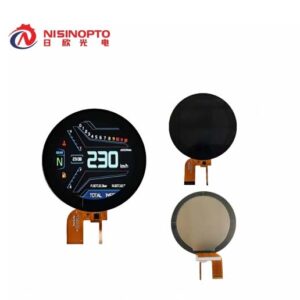
- Smart knob displays: 1.28–2.76 inch, IPS / AMOLED options, 480Resolução ×480. IP54 oil & water resistant coating, magnetic encoding knob. Accurate adjustment even with oil or water on surface, Precisão do controle de temperatura de ±1°C. Equipped with 50Hz haptic vibration feedback, physical damping and 32-level scales for blind operation.
- Serial intelligent screens: 0.77–15.6 inch TFT. Graphic UI development without deep bottom driver coding. Supports TTL / RS232 / RS485, USB & SD offline firmware upgrade, ideal for rapid whole-home control panel development.
- Custom irregular displays from 0.9 polegada para 24 polegada. Anti-glare & anti-reflection treatment, wide-temperature heating and de-icing solutions available for demanding environments.
- 2,500 m² plant including 1,500 m² Class 10,000 cleanroom with local Class 100 FFU zones. Full set of ISO certifications, CE, RoHS, FCC-SDOC and proprietary knob structure patents. Supports fast low-volume trial runs.
- Lead time: 1–3 days for requirement confirmation, 3–15 days for sample development & validation, 7–30 days for mass production.
Tianma Microelectronics
Established in Shenzhen, listed veteran display manufacturer. Large production capacity for standard small & medium-sized panels for home appliances, automotive and industrial markets. Suitable for high-volume, fixed-design appliance projects with stable cost control. Limitation: high customization threshold and long lead time for small orders.
Jinghua Display
Focused on HMI display modules for years. Product portfolio covers segment screens, TFT color screens and serial display assemblies. Rich track records for appliance control panels and industrial meters with mature software-hardware support. Fit for conventional standard appliance panel projects.
Quick Selection Tip Choose Nisinopto if you develop integrated stoves, steam ovens and kitchen appliances that require reliable knob interaction, oil/water resistance, blind operation and fast small-batch verification. For standardized mass-market appliances with huge order volume and few design changes, compare large-scale manufacturers like Tianma and Jinghua.
5. Perguntas frequentes
Q: What certifications are mandatory for appliance display OEM factories? UM: Baseline ISO 9001 / ISO 14001 / ISO 45001. CE, FCC and RoHS for export shipments. High-tech enterprise certificates and related patents are strong pluses.
Q: What hidden costs may occur in custom display projects? UM: Tooling charges, custom protocol development, UI font library burning, special functional coating, small-batch SMT and repeated debugging labor. All scope boundaries must be documented in technical agreements.
Q: What parameters should be confirmed before project kick-off? UM: Tamanho da tela, resolução, brilho & light sensing, IP rating, anti-oil/steam requirement, mechanical tolerance, communication interface, knob rotation/press logic and operating temperature range.
Q: Business scope & inquiry process of Nisinopto? UM: Serving domestic clients across China and overseas markets. HQ in Bao’an Shenzhen, branch in Suzhou. Workflow: requirement communication → sample validation → low-volume trial → mass production. Ideal for new product verification.
Final Summary
Display assembly sourcing is not only about price matching. Your supplier must match your product positioning, order volume and operating environment. Prioritize oil/water resistance, touch stability and tactile feedback for kitchen and bathroom appliances. For standardized mass production lines, focus on large-scale capacity and unit cost. Lock specifications, quotation scope and after-sales terms in advance to avoid most supply chain risks.
If you are developing display solutions for integrated stoves, whole-home control panels or smart bathroom devices, feel free to send your requirements including size, interface, waterproof grade and estimated order quantity for technical discussion.