

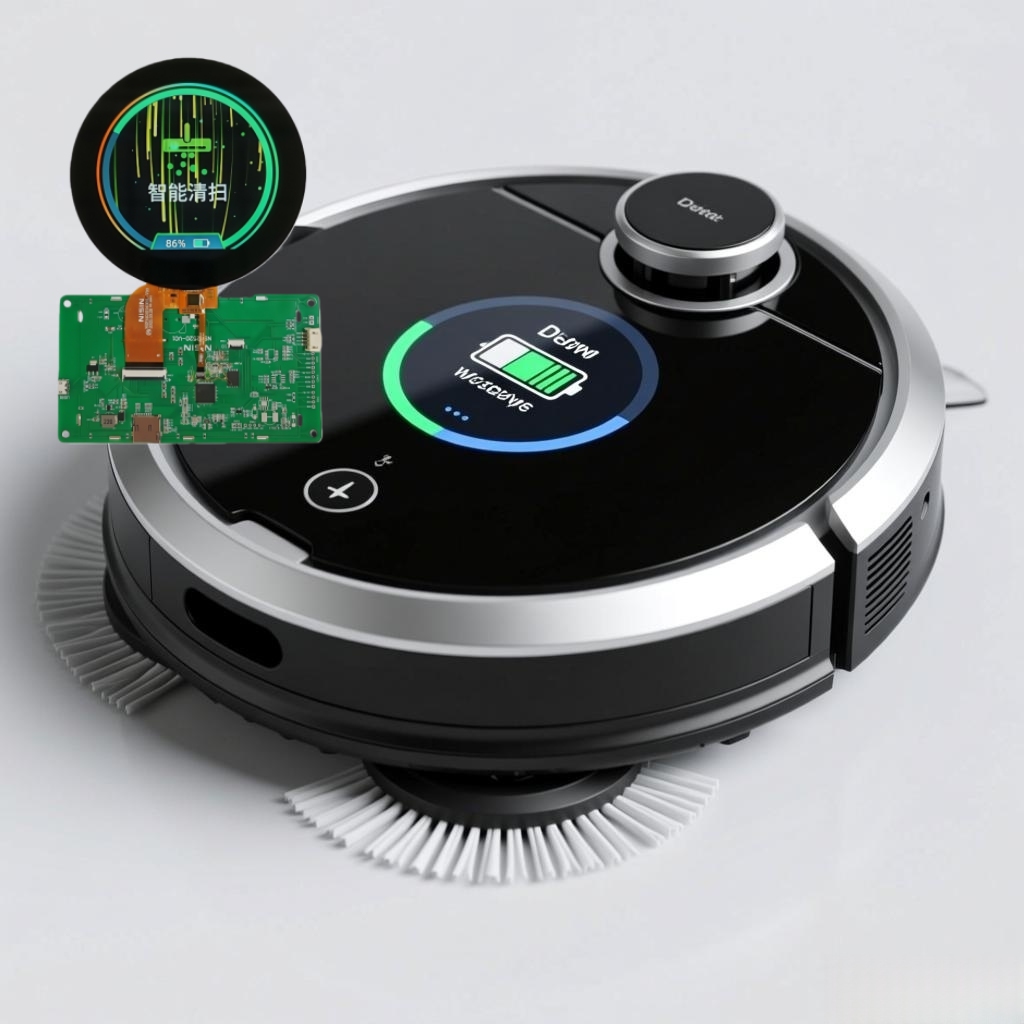
In today’s increasingly prevalent smart home devices, user expectations for appliance interaction have surpassed basic functionality. Shenzhen Optoelectronics’ 4-inch circular touchscreen (720×720 resolution) is revolutionizing the robotic vacuum cleaner industry with its unique design, bringing a revolutionary upgrade to the interactive experience. This article will delve into how this circular touchscreen enhances the user-friendliness and operational efficiency of cleaning equipment through a visual interface and intuitive operation.
Core Product Advantages
1. Dynamic Visual Feedback System
Traditional robotic vacuum cleaners rely on indicator lights or mobile app push notifications for status information, which suffer from information delays and interpretation barriers. This circular touchscreen innovatively adopts:
Circular Progress Visualization: Key data, such as cleaning progress, water level adjustment, and battery status, are presented with dynamic circular animations.
Real-time Status Animation: Different cleaning modes are accompanied by dedicated animated icons, making the working status clear at a glance.
High-Definition Display Quality: 720×720 resolution ensures clear and delicate graphics and text display without jagged edges.
2. Intuitive Touch Interaction Design
One-Click Mode Switching: Cleaning modes (sweeping, mopping, deep cleaning of corners) and suction/water level adjustment can all be completed directly by touch.
Circular Menu Layout: Conforms to the natural gliding trajectory of the finger, improving operation smoothness by approximately 40%.
Anti-accidental Touch Optimization: Algorithm optimization for common accidental touch scenarios in the home environment reduces the accidental operation rate to below 2%.
3. Seamless Integration and Compatibility
Standard Serial Port Protocol: Supports multiple communication interfaces such as UART and I2C, enabling quick interface with mainstream robot vacuum motherboards.
Low Power Consumption Design: Standby power consumption <0.5W, not affecting overall device battery life.
Multi-Language Interface: Supports display in 12 languages, including English, Spanish, French, and German.
Application Scenarios and Enhanced User Experience
Home Daily Use Scenarios
Elderly User-Friendly: Large font display and intuitive icons reduce learning costs.
Quick Operation Needs: No need to open a mobile app; instant response to changes in cleaning needs.
Instant Status Confirmation: Clearly displays the robot vacuum’s work progress and remaining time.
Commercial Cleaning Scenarios
Multi-Device Management: Visualized cleaning progress facilitates simultaneous monitoring of multiple devices.
Maintenance Reminder Function: Directly displays maintenance reminders such as filter replacement and water tank cleaning.
Comparison with Traditional Interaction Methods
Limitations of Traditional Interaction Methods:
Mobile App Dependence: Operation requires opening the application, which can result in network latency and connection issues.
Indicator Light Limitations: Limited information capacity, ambiguous status interpretation.
Voice Control Challenges: Environmental noise affects recognition rate; privacy concerns exist.
Circular Touchscreen Solution:
This Localized Interaction: All operations respond instantly on the device, with zero latency.
Information Richness: Can display 8-10 key parameters simultaneously.
Privacy Protection: Sensitive operations do not require intervention from the cloud server.
Installation and Integration Guide
Hardware Integration Steps
Interface Interaction: Connect to the main control board via standard serial port.
Power Management: Connect to the device’s power supply system (supports 3.3V/5V).
Structural Fixing: Circular design adapts to the top structure of most robotic vacuum cleaners.
Software Configuration Process
Protocol Configuration: Select the appropriate communication protocol and baud rate.
Interface Customization: Adjust interface elements using the included tools. Layout and Functionality Testing: Comprehensive testing of touch response and data display accuracy.
Market Feedback and Case Studies: Based on a follow-up survey of 500 early adopters:
User Satisfaction: 94% of users felt that ease of operation was significantly improved.
Learning Curve: 87% of users mastered all basic operations within 10 minutes.
Recommendation Intention: 91% of users indicated they would recommend this interaction design to others.
Real-world Case: After a well-known robotic vacuum cleaner brand adopted this circular screen in its new 2024 products, customer service inquiries decreased by 35%, and product satisfaction rates increased by 28%.
Industry Impact and Future Outlook
This 4-inch circular touchscreen not only solves the current pain points of robot vacuum interaction, but also provides new ideas for human-computer interaction design in smart home devices:
Form Innovation: Proving the practicality and aesthetics of circular screens on dedicated devices
Interaction Paradigm: Establishing a new display standard of “circular progress + central function.”
Extended Applications: Its design concept can be extended to other home appliances (air purifiers, smart ovens, etc.)
As IoT devices develop towards more natural interaction, this design philosophy of transforming complex data into intuitive visual feedback is expected to become one of the standard configurations of future smart home appliances.
Conclusion
Shenzhen Optoelectronics’ 4-inch circular touchscreen effectively solves the long-standing problems of unintuitive operation and ambiguous status feedback in robot vacuums through its innovative circular visual design and intuitive touch interaction. Its 720×720 high-definition display, low power consumption design, and strong compatibility make it an effective solution for robot vacuum manufacturers to enhance product competitiveness, and also provide a referable example for the upgrading of human-computer interaction in the entire smart home industry.
For smart device manufacturers that pursue an excellent user experience, investing in such innovative interfaces is not only an effective way to differentiate their products but also an inevitable choice to meet modern consumers’ expectations for an “intuitive, instant, and enjoyable” interactive experience.