

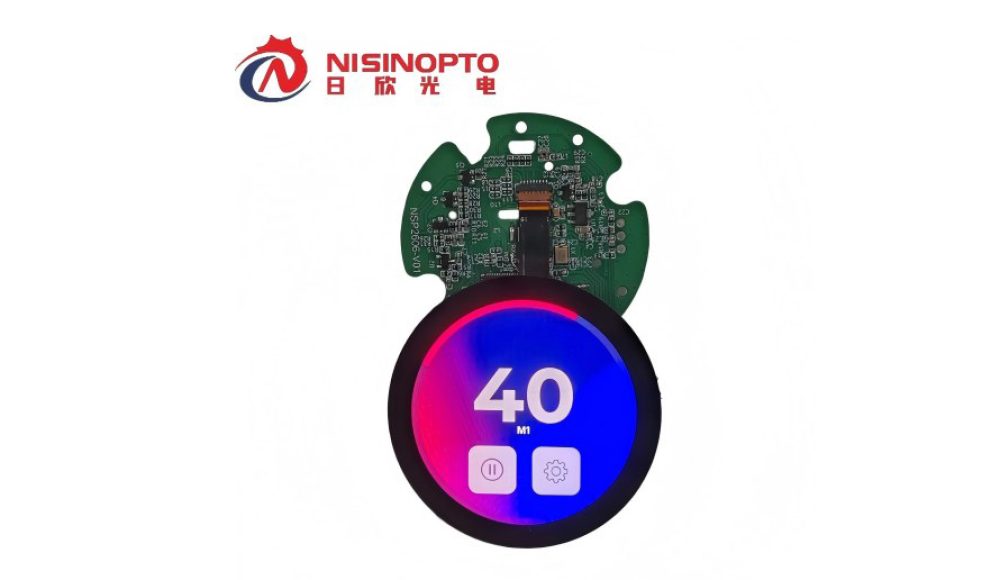
A smart home control panel needs to do more than display information. Users expect to adjust settings quickly, check device status at a glance, and navigate functions without working through complicated menus. Для производителей, the challenge is to fit these functions into a compact interface that also matches the product’s overall design.
This is one reason round touch displays are attracting attention in smart home product development. Their compact shape offers a different approach to interface design, while an AMOLED display can deliver vivid colors, глубокие черные, and clear visual feedback.
For smart home brands and OEM manufacturers, choosing the right display involves more than appearance. Разрешение, яркость, communication interfaces, installation space, and operating temperature all affect how a display module performs in the finished product.
Why Consider a Round Touch Display for Smart Home Controls?
Traditional control panels often rely on physical buttons, индикаторные лампы, or rectangular screens. These solutions remain practical for many applications, but products with more functions may need a more flexible interface.
A round touch display allows manufacturers to organize controls around a central visual area. В зависимости от приложения, the screen can present operating modes, настройки температуры, таймеры, статус устройства, or other information within a compact layout.
Например, a smart thermostat may need to show the current temperature while allowing users to adjust their preferred setting. A smart lighting controller may need to provide quick access to brightness and lighting modes. A home appliance interface may combine operating information with several user-selectable functions.
The circular shape does require thoughtful interface design. Designers need to place important information where users can read it easily and keep touch controls accessible without crowding the edges. When the screen, программное обеспечение, and physical controls work together, a round interface can become a practical option for compact smart home equipment.

How Does AMOLED Technology Improve the Display Experience?
Display quality directly affects how users interact with a control panel. Small text, unclear status indicators, or poor contrast can make an otherwise capable product harder to use.
An Модуль дисплея AMOLED offers several characteristics that can support a clear, visually engaging interface.
High Resolution for Compact Interfaces
NISIN’s AMOLED display module features a 466 × 466 разрешение. This resolution gives product designers room to arrange icons, информация о статусе, and control elements within a small circular display area.
Однако, resolution alone does not determine usability. Font size, spacing, icon design, and the amount of information displayed at once also matter. For smart home interfaces, a focused layout often works better than placing every available function on the same screen.
Rich Colors and High Contrast
The module supports 16.7 million colors and a specified contrast ratio of 100,000:1. These characteristics can help designers distinguish interface elements, highlight selected modes, and present status information with clear visual separation.
AMOLED technology can also produce deep blacks, which can make dark interface themes visually effective. Designers can use contrast and color carefully to separate active controls from background elements without making the interface unnecessarily busy.
The goal is not to fill the display with visual effects. It is to help users recognize information and complete common tasks with less effort.
Fast Response and Viewing Comfort
NISIN specifies a 3 ms response time and a minimum brightness of 350 cd/m² for this display module. These specifications provide useful reference points when evaluating the module for a particular control panel.
Actual readability depends on the product enclosure, окружающее освещение, display settings, расстояние просмотра, and installation angle. Manufacturers should test the finished device under the conditions in which users will operate it rather than relying on individual display specifications alone. For control panels mounted on walls or integrated into appliances, wide viewing angles can also help users read information from different positions.

Why Do Size and Mechanical Integration Matter?
A display may look suitable in a product concept but still create difficulties during hardware development. The module must fit the enclosure, align with the visible opening, and connect to the main control board.
NISIN’s display module measures 52.8 × 52.8 × 1.66 мм, with a display area of 43.76 × 43.76 мм.
Its compact dimensions may suit applications where the control interface needs to occupy limited space. The difference between the module dimensions and the display area is especially important during mechanical design. Engineers must allow for the surrounding structure, mounting method, connector location, and any additional components required by the final assembly.
Before confirming a design, product teams should check the module drawing, требования к монтажу, connector position, and integration tolerances. They should also consider how the display will be protected within the enclosure. These checks can reduce avoidable redesign work when moving from a prototype to mass production.
How Does TTL Serial Communication Support Integration?
Hardware compatibility is another important consideration when selecting an AMOLED display module.
NISIN’s module supports TTL serial communication, which provides a communication interface for integration with a compatible host controller. This can suit embedded product designs where the main controller manages the display and related user interactions.
Before integration, engineers should confirm the electrical interface, voltage levels, pin definitions, протокол связи, supported commands, and available software documentation. They also need to verify that the host controller can communicate with the module as required by the intended application.
The word serial alone does not guarantee compatibility with every controller. TTL serial communication is not automatically interchangeable with interfaces such as RS-232, RS-485, СПИ, or I²C. The actual electrical and protocol requirements must match. Early interface testing is especially useful for OEM projects. It allows the engineering team to verify basic communication and display behavior before investing time in the full user interface.

Can a Round AMOLED Display Handle Different Operating Environments?
Smart home products do not all operate under the same conditions. A wall-mounted controller, a wearable device, and an industrial instrument may encounter different temperatures and installation environments.
NISIN specifies an operating temperature range of -20°C to +70°C and a storage temperature range of -30°C to +80°C for this module.
These ranges give engineers a starting point when assessing environmental compatibility. They should still compare the specifications with the actual conditions inside the finished product. Enclosure design, heat generated by nearby components, installation location, and thermal management can all affect operating conditions.
For devices installed near heat sources or in areas with significant seasonal temperature changes, environmental testing can help reveal issues before production begins.
Manufacturers should also verify any additional requirements for humidity resistance, вибрация, защита от ударов, or long-term reliability. These characteristics cannot be assumed from the temperature range alone.
Where Can Round Touch Displays Be Used?
A compact round display can serve different product categories, depending on its interface, механическая конструкция, and communication compatibility.
Системы управления умным домом: A round display can present temperature settings, lighting controls, operating modes, or device status in a compact interface.
Smart appliances: Coffee machines, кухонная техника, and other connected products may use a display to organize settings and provide feedback during operation.
Носимые устройства: Compact dimensions and high-resolution graphics can support small interfaces, provided the complete module meets the wearable product’s power, mechanical, and touch requirements.
Промышленные инструменты: Embedded equipment may use a compact display to present operating information or let users interact with local settings. The final design must match the instrument’s environmental and functional requirements.
For each application, engineers should evaluate the display as part of the finished device. Screen size and resolution are important, but so are communication compatibility, touch behavior, энергопотребление, enclosure design, and software support.

Why Work with NISIN on a Custom AMOLED Display Module?
Standard display specifications provide a useful starting point, but different products often require different integration details. A display intended for a wearable device may have different mechanical constraints from one designed for a smart home controller or industrial instrument.
NISIN offers customization services for applications including wearable devices, системы управления умным домом, промышленные инструменты, and other embedded products.
For OEM and ODM manufacturers, an early technical review can help establish whether a module fits the intended design. Useful items to confirm include the mechanical drawing, interface documentation, touch configuration, operating requirements, and available customization options.
Product teams should also clarify sample availability, validation requirements, production planning, and any application-specific technical support before finalizing the design.
The aim is to select a display solution that works with the product’s hardware and software architecture, not simply to choose a screen with an attractive specification sheet.
Заключительные мысли
Round touch displays offer another way to design compact, modern smart home control panels. Their circular form can support focused interfaces, while AMOLED technology provides rich colors and high contrast for clear visual feedback.
Нисин 466 × 466 AMOLED display module combines a compact 52.8 × 52.8 mm form factor with TTL serial communication and a specified operating temperature range of -20°C to +70°C. These characteristics make it worth evaluating for suitable smart home control systems and other embedded applications.
The final decision should come from the complete product requirements. By checking display quality, совместимость интерфейса, mechanical dimensions, environmental conditions, and customization needs early, manufacturers can select a module that fits the intended application and reduces integration uncertainty.