
In today’s booming specialty coffee culture, the human-computer interaction experience of coffee machines is becoming a key factor influencing user choices. Traditional touchscreens frequently malfunction in oily or water-stained environments, while pure button operation struggles to provide visual parameter adjustments, leaving many coffee enthusiasts in a dilemma when purchasing equipment. Addressing this industry pain point, intelligent interactive components integrating physical knobs and high-definition displays are gradually becoming the mainstream solution for coffee machine upgrades.
Key Function Analysis: How Dual-Mode Interaction Reconstructs Operation Logic
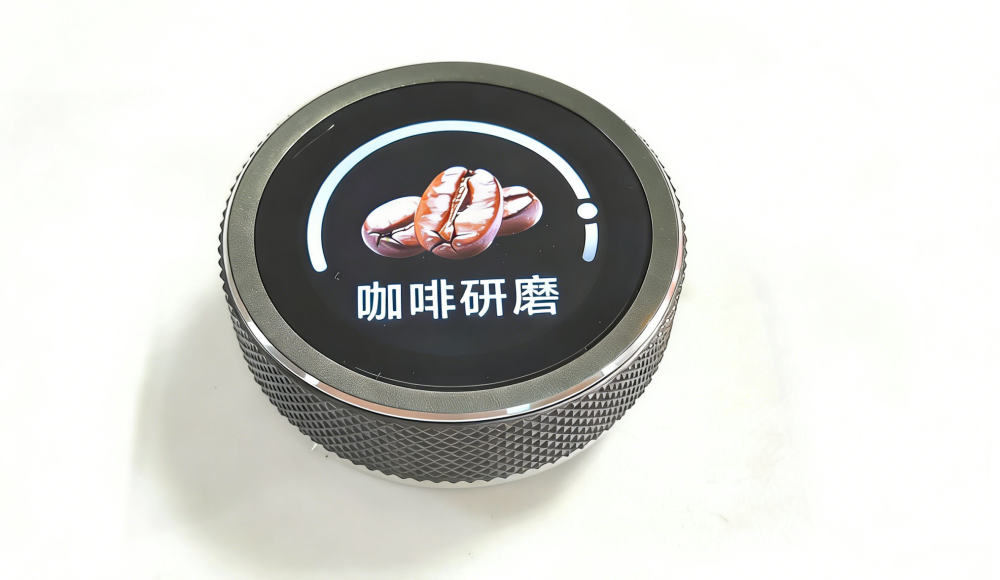
The technological breakthrough of the pressable intelligent knob screen lies in the implementation of the dual-mode interactive system. This solution deeply integrates three operation methods: rotation adjustment, press confirmation, and touch selection. Users can accurately adjust parameters such as temperature and extraction time using the physical knob, or directly select coffee modes via the touchscreen after cleaning their hands. This design has been validated in the tea bar machine project of Anhui Electric Spark Technology Co., Ltd.: the intelligent knob screen enables accurate switching between 5 to 11 water temperature levels, improving temperature control accuracy to ±1℃, significantly optimizing the operating experience for the elderly and children.
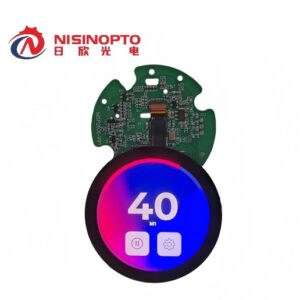
In terms of display performance, the knob screen using IPS/AMOLED technology achieves a resolution of 480×480, supporting real-time display of extraction parameters, countdown progress, and other operating statuses. Shenzhen Rixin Optoelectronics offers a multi-size product line ranging from 1.28 inches to 2.76 inches, adaptable to different scenarios, from home semi-automatic coffee machines to commercial fully automatic equipment. Notably, the integrated wireless connectivity module supports Bluetooth 5.0 and WIFI 2.4G protocols, enabling direct control via mobile app, remote data reporting, and firmware OTA upgrades, providing a technical foundation for intelligent operation and maintenance.
Extreme Environment Adaptability Tests
Given the specific characteristics of coffee making, waterproof and stain-resistant performance directly determines the equipment’s lifespan. Test data shows that the knob screen solution with an IP65 waterproof structure, combined with an oil-resistant coating, can support operation in a temperature range of -35℃ to 70℃, with an operational stability of 99.5%. This means that even under continuous operation in high-temperature steam environments, or after being splashed with coffee or milk, the equipment can still maintain normal responsiveness.
The introduction of blind operation tactile feedback technology solves the high-frequency operation pain points in commercial scenarios. Uniform physical damping combined with a raised dot positioning design ensures that single-handed operation error is controlled within one level. When making espresso, baristas can fine-tune the grind size and extraction pressure without turning their eyes from the coffee machine to the control panel. This feature is also applied in Dreame Technology’s advanced smart faucet project, which successfully resisted 4KV contact static electricity and 8KV air static electricity, eliminating the risk of electrostatic failure in the metal body and achieving zero functional failure delivery.
Customization Capabilities and Supply Chain Support: Shenzhen Rixin Optoelectronics, a high-tech enterprise specializing in LCD display module R&D, has a 2,500-square-meter factory equipped with a 1,500-square-meter cleanroom (reaching Class 10,000, with local Class 100 FFU purification), providing closed-loop solutions from design and prototyping to mass production. The company owns 23 computer software copyrights, 13 utility model patents, and 4 invention patents. Among them, the patents for “a pressable knob screen” and “a knob screen anti-detachment structure” effectively solve the structural durability problem under high-frequency pressing scenarios.
Regarding its quality control system, the company has obtained ISO9001 quality management system, ISO14001 environmental management system, and ISO45001 occupational health and safety management system certifications, maintaining a high IQC (Independent Quality Control) pass rate. Of its more than 200 employees, 45% are in R&D, and 20% are in quality control. Chairman Chen Mingkuan has over 20 years of industry experience, and R&D Director Qiu Liting has 23 years of experience in LCD development, providing technical support for product stability.
Industry Application Trend Observation: Market feedback indicates that smart knob screens have broken through the single application scenario of kitchen appliances. In vehicle central control systems, physical knobs can avoid the risk of accidental touches while driving; in smart home panels, the interactive method of rotating to adjust light brightness and curtain opening is more intuitive for users. Tianlong Century’s outdoor mobile agricultural machinery equipment project shows that a high-brightness display solution combining AR technology and an anti-reflective coating can maintain a clarity of ≥95% in an environment with 10,000 lux of light and reduce fuel consumption by 15%.
For coffee machine manufacturers, choosing a display solution that supports offline maintenance systems is crucial. Shenzhen Rixin Optoelectronics’ serial port screen solution supports dual upgrade modes via USB/SD card, allowing for on-site updates of interface resources and firmware without the need for disassembly and factory return. This design has been widely adopted in scenarios requiring frequent functional iterations, such as charging piles and industrial instruments. Its compatibility with multiple industrial-grade protocols, including TTL/RS232/RS485, ensures stable communication even in strong electromagnetic environments.
Technological Evolution and Selection Recommendations
Currently, smart rotary display screens are developing towards higher resolution and lower power consumption. The introduction of AMOLED technology has significantly improved contrast and response speed, while enhanced adaptability to irregular shapes makes it possible to design control panels for coffee machines with special shapes such as circles and rectangles. Shenzhen Rixin Optoelectronics offers a full range of display assemblies (LCM) from 0.9 inches to 24 inches, supporting customized brightness from 200-3000 cd/m², meeting diverse needs from home to commercial, and from indoor to outdoor use.
For coffee equipment manufacturers, three key dimensions should be considered when selecting a model: the protection level of the operating environment must match the intensity of moisture and oil contamination in the actual usage scenario; the brightness range of the display module should consider the lighting conditions of the store; and the compatibility of the communication protocol directly affects the integration difficulty with the main control system. Experience from serving over 1000 industry clients shows that conducting small-batch trial production verification in advance can effectively reduce the risk of rework after mass production.
The dual-base layout, from the Shenzhen headquarters to the Suzhou branch, along with a business network covering 40% of South China, 30% of East China, 20% of Central China, and 10% overseas, provides geographical support for rapidly responding to customized customer needs. As the specialty coffee market continues to demand more intelligent and user-friendly equipment, smart rotary screens, combining the advantages of physical interaction and digital display, are becoming standard features in the next generation of coffee machines.